Category Archives: Mexican History

Flag Day, Dia de la Bandera

February 24 – Mexican Flag Day, Dia de la Bandera de México

mexican-flag-bandera-6179-2

Mexico flag. Photo: BigStockPhoto.com/ by daboost

Pledge of Allegiance Flag of Mexico

Legacy of our heroes, Symbol of unity
Of our parents and our brothers,
we promise always be faithful
to the principles of freedom and justice
that make our country an independent nation, humane and generous,
to which we give our existence.
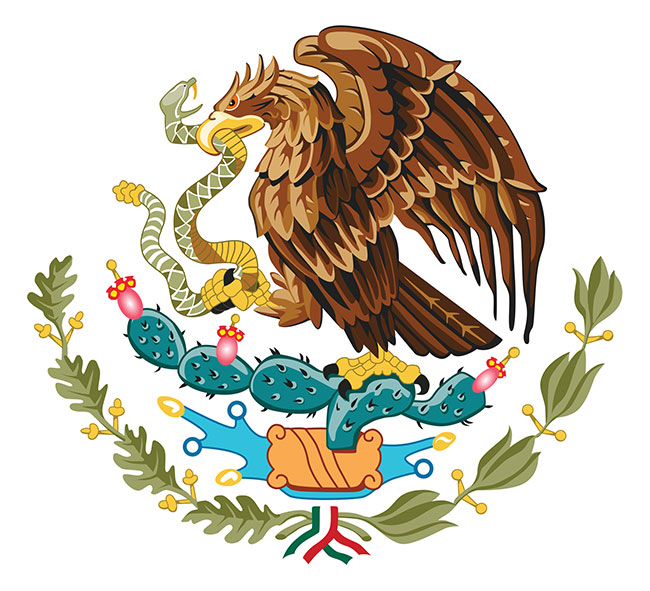
mexico-coat-of-arms-5200-2

Mexico Coat of Arms
Photo:  BigStockPhoto.com | Speedfighter

This civic holiday celebrates the Mexican flag and honors previous iterations. The holiday dates to 1937, when it was implemented by then-president Lázaro Cárdenas. The national flag, which features vertical stripes of red, white and green with the national coat of arms in the middle of the white stripe. Photo shows  Mexico Flag with enlarged coat of arms.

Mexicans first celebrated the country’s current flag on February 24, 1937. The design of this flag was used in 1821 and the current flag was officially adopted in 1968. Its colors – red, white, and green – are the National Liberation Army’s colors.
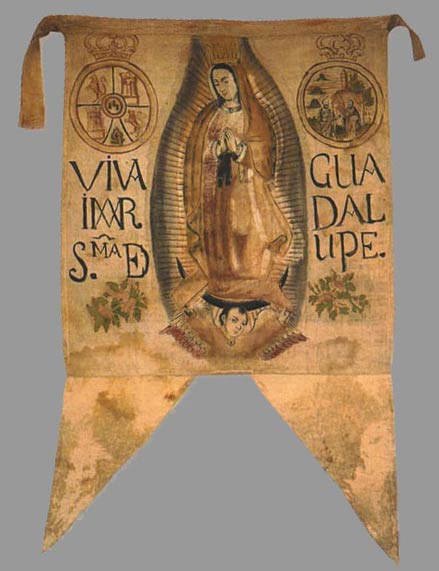
banner-guadalupano

Standard of the Virgin of Guadalupe carried by Miguel Hidalgo during the start of Mexico’s War of Independence in 1810. Image by Marcuse

Brief History of the Mexican Flag
The first flag was the banner of the Virgin of Guadalupe taken by the Atotonilco Chapel by the father of the nation, Don Miguel Hidalgo.  In Zitácuaro, Michoacan , on August 19 , 1812, emerged the flag of Generalissimo Morelos. This was a white frame with white and purple squares on the edges, an imperial eagle on the center, surrounded by a caption that says: ” UNGUIBUS EQUE VIC TRIX OCULIS ET”.

The Pennant “El Dolente de Hidalgo” was another flag used by the insurgents in the principles of the cause; it was red with crossed black stripes, a skull on the center of two crossbones in form of a cross.  The flag of the Insurgents, which was greeted with 19 cannon gunshots in New Orleans, it was formed by three vertical stripes: white, purple and red.


mexico-bandera-flag-2

Current Mexican Flag

“Trigarante Army Flag.” Born to the proclamation of the ” Plan of Iguala ” on February 24, 1821 , this date was subsequently chosen to celebrate the ” Day of the Flag ” .
The colors of this flag were the same as current and actual one, but placed differently and in diagonal stripes: first white , symbol of the ” Religion” , the center green ¨Independence¨, and finally the red symbolizing the “Union”, in the green stripe center there is an imperial crown with the motto of the three guarantees.

The Iturbide Empire Flag, replaced for the Iguala Flag, was the first to adopt the order of the present flag colors and the eagle in the center area , the difference was the position of the eagle holding an imperial crown.

The Republican Flag, enacted on April 14, 1823, was the most similar to the present flag; on this one appears the eagle but changed by placing it in front. The National Flag, as we know it today, waved for the first time in the National Palace on September 15, 1917.

————-

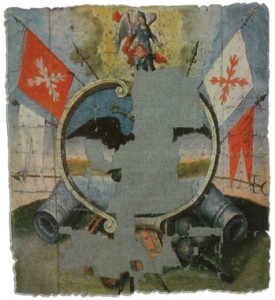
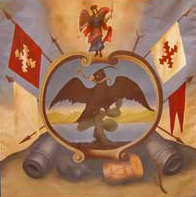
Back in the days, Spain had the last word. But today, and honoring Mexico’s festive mood, the Spaniards have sent back Hidalgo’s flag. It is the very flag that had been captured in Mexico in 1810/1811. It had been brought to Spain and put on display there in the Spanish Museo de Artillería (Artillery Museum).  Here is the good piece:

Source: www.emersonkent.com/history_notes/miguel_hidalgo_y_costilla.htm

historia-bandera-mexicana-pulsodigital-net

Images of the history of the Mexican Flag – Historia de la Bandera Mexicana – Photo: pulsodigital.net

A list of prior versions of the Mexican Flag can be found here:
https://en.wikipedia.org/wiki/List_of_Mexican_flags  and more here:
https://en.wikipedia.org/wiki/Flag_of_Mexico

Ignacio Zaragoza Seguín

Ignacio Zaragoza Seguín, (March 24, 1829 – September 8, 1862) was a general in the Mexican army, best known for defeating invading French forces at the Battle of Puebla on May 5, 1862 (now celebrated in both the United States and Mexico as the Cinco de Mayo).
Zaragoza was born in the early Mexican Texas village of Bahía del Espíritu Santo (now Goliad, Texas, in the United States) in what was then the Mexican state of Coahuila y Texas.
https://en.wikipedia.org/wiki/Ignacio_Zaragoza

When “Cinco de Mayo” is mentioned in Mexico, one of the most symbolic battles in the Mexican collective unconscious immediately comes to mind: the Battle of Puebla.  General Ignacio Zaragoza, with only a small army, took on the powerful French forces of Napoleon III during the Second French Intervention.

Ignacio Zaragoza Seguin was born on March 24, 1829 in the city of Presidio de La Bahia de Espiritu Santo, now Goliad, in southern Texas, USA. He was the second son of the marriage between Miguel Zaragoza and Maria de Jesus Valdez  Martinez Seguin.

When he was five years old, after the independence of Texas, his family moved to  Matamoros in Tamaulipas state, where he began his studies and ten years later he moved to Monterrey, Nuevo Leon.

For several years he leaned toward the priesthood, but then left, perhaps to continue the example of his father, who was an infantryman.

During the United States intervention in Mexico between 1846 and 1848,young  Zaragoza tried to enlist as a cadet, but was rejected.

He saw, however, from a distance, how Mexico lost more than half of its territory in an unequal war.  It was not until 1853 that he managed to enter the Nuevo Leon army, first as a sergeant, then later as captain of his regiment. In 1854, he decided to join the Plan de Ayutla, a movement that attempted to overthrow the dictator Antonio Lopez de Santa Anna.  article continues.
https://www.inside-mexico.com/historia/ignaciozaragoza.htm

ignacio-zaragoza-500-pesos-2008-2

image of Ignacio Zaragoza on a 500 pesos Mexico banknote – 2008 – Photo: Joseph A. Tyson

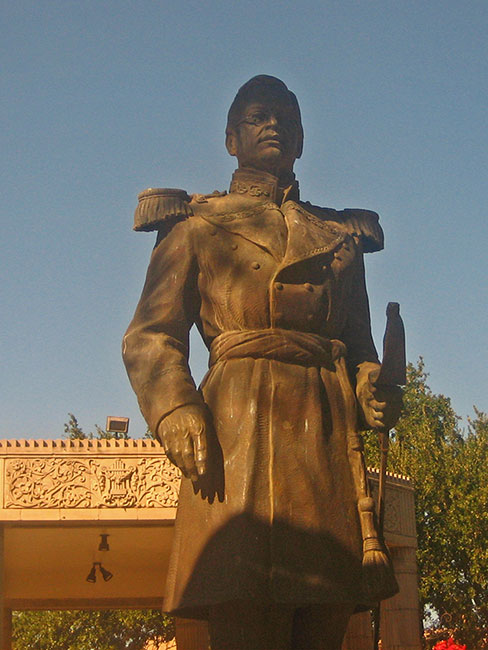
Statue of General Ignacio Zaragoza in San Agustin Plaza in the downtown historic district of Laredo, Texas. Attribution: Billy Hathorn https://en.wikipedia.org/wiki/User:Billy_Hathorn

Statue of General Ignacio Zaragoza in San Agustin Plaza in the downtown historic district of Laredo, Texas. Attribution: Billy Hathorn / wikipedia.org/wiki/User:Billy_Hathorn


Porfirio Diaz

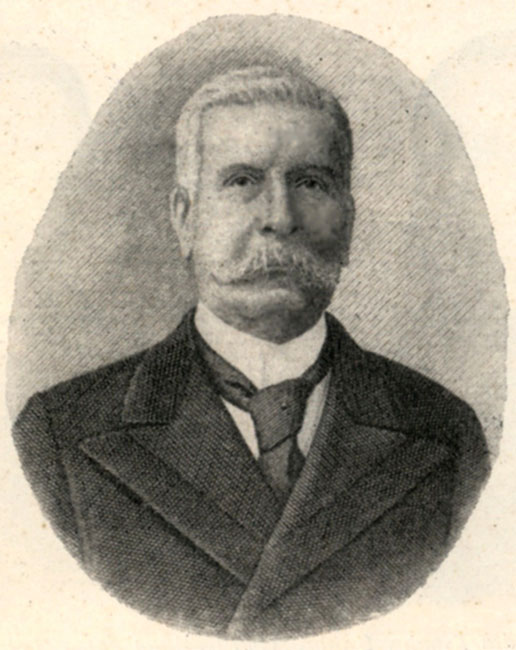
porfirio-diaz-2Porfirio Diaz (1830-1915) became a war hero during the French invasion of 1861, helping to defeat the invaders at the famous Battle of Puebla on May 5, 1862. He entered politics and followed the rising star of Benito Juarez, although the two men did not get along well personally. In 1876 he grew tired of trying to reach the Presidential palace democratically: he entered Mexico City with an army and not surprisingly won the “election” he set up himself.

Pintura del entonces Presidente de México Porfirio Díaz Mori (1830-1915), exhibida en el museo del Templo y Ex-Convento de Santo Domingo de Guzmán, en la ciudad de Oaxaca de Juárez, Oaxaca, México. commons.wikimedia.org/


Porfirio-Diaz-1867-public-domain

Porfirio Diaz – Circa 1867 – Public Domain image

Porfirio-Diaz-circa-1880-ak-2

Porfirio Diaz – Circa 1880 – Public Domain image

Hernán Cortés

Hernán Cortés (1485-1547)

hernan-cortes

Hernán Cortés – Public Domain Image

Hernán Cortés de Monroy y Pizarro, 1st Marquis of the Valley of Oaxaca was a Spanish Conquistador who led an expedition that caused the fall of the Aztec Empire and brought large portions of mainland …  Wikipedia

Hernán Cortés (1485-1547) was a Spanish conquistador, responsible for the audacious conquest of the Aztec Empire in Central Mexico in 1519. With a force of 600 Spanish soldiers he was able to conquer a vast Empire that had tens of thousands of warriors. He did it through a combination of ruthlessness, guile, violence and luck.

Cortés never lost the spirit of adventure. He personally financed and led an expedition to explore Baja California in the late 1530’s and fought with royal forces in Algiers in 1541. After that ended in a fiasco, he decided to return to Mexico, but instead died of pleuritis in 1547 at the age of 62.

Francisco Ignacio Madero González

Francisco Ignacio Madero González

franciso-madero-stamp-4393-2
A stamp dedicated to  Francisco Ignacio Madero Gonzalez a politician, writer and

revolutionary who served as President of Mexico from 1911 to 1913.
Photo circa 1985. bigstockphoto.com | markaumark


francisco-i-madero-portrait
Francisco Ignacio Madero González
(30 de octubre de 1873 – 22 de febrero de 1913)

https://es.wikipedia.org/wiki/Francisco_I._Madero

Born in Coahuila on October 30, 1873. Son of a wealthy landowner. Family was devoted to ranching, farming and commerce. Studied commerce and economics in France and agriculture in the U.S. Saw the need to improve conditions in Mexico.

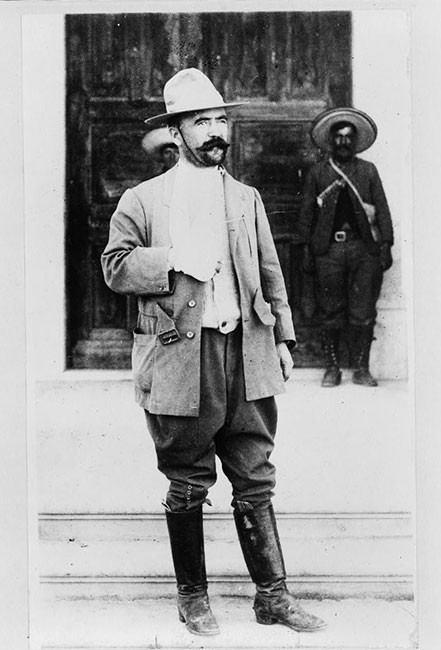
Francisco-Madero-3c00794v-2General Madero, Mexican political leader, full-length portrait, standing,
facing right,  with hand in sling, after being wounded at Casas Grandes.
Date Created/Published: c1911.  Medium: 1 photographic print.
Library of Congress:  https://hdl.loc.gov/loc.pnp/cph.3c00794