Category Archives: Holidays in Mexico

Holy Saturday, Sábado Santo

April 4, 2015 – Holy Saturday, Sábado Santo

Holy Saturday (Sábado Santo) is a Christian holiday in Mexico prior to Easter Sunday. Solemn vigils are held at churches on this day.

Holy Saturday (Latin: Sabbatum Sanctum) i.e. the Saturday of Holy Week, also known as the Great Sabbath, Black Saturday, or Easter Eve, and called “Joyous Saturday” or “the Saturday of Light” among the Copts, is the day after Good Friday. It is the day before Easter and the last day of Holy Week in which Christians prepare for Easter. It commemorates the day that Jesus Christ’s body lay in the tomb. https://en.wikipedia.org/wiki/Holy_Saturday

Jesus is laid in the tomb, fresco paintings on the ceiling of the church. Photo: zatletic

Jesus is laid in the tomb, fresco paintings on the ceiling of the church.
Photo: BigStockPhoto.com | zatletic
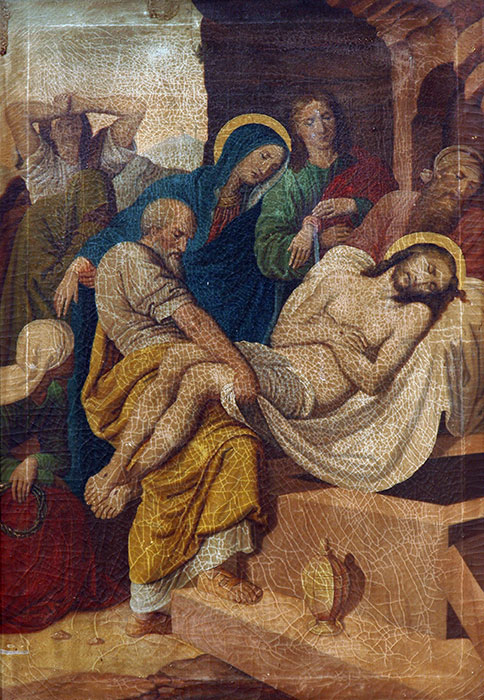
14th Stations of the Cross, Jesus is laid in the tomb and covered in incense

14th Station of the Cross, Jesus is laid in the tomb and covered in incense. Photo: BigStockPhoto.com | zatletic

Holy Saturday (from Sabbatum Sanctum, its official liturgical name) is sacred as the day of the Lord’s rest; it has been called the “Second Sabbath” after creation. The day is and should be the most calm and quiet day of the entire Church year, a day broken by no liturgical function. Christ lies in the grave, the Church sits near and mourns. After the great battle He is resting in peace, but upon Him we see the scars of intense suffering…The mortal wounds on His Body remain visible….Jesus’ enemies are still furious, attempting to obliterate the very memory of the Lord by lies and slander.

Mary and the disciples are grief-stricken, while the Church must mournfully admit that too many of her children return home from Calvary cold and hard of heart. When Mother Church reflects upon all of this, it seems as if the wounds of her dearly Beloved were again beginning to bleed.  https://www.catholicculture.org/culture/liturgicalyear/calendar/day.cfm?date=2014-04-19

Activities

  • Today we remember Christ in the tomb. It is not Easter yet, so it’s not time for celebration. The day is usually spent working on the final preparations for the biggest feast of the Church year. The list of suggested activities is long, but highlights are decorating Easter eggs and attending a special Easter food blessing.
  • For families with smaller children, you could create a miniature Easter garden, with a tomb. The figure of the risen Christ will be placed in the garden on Easter morning.
  • Another activity for families is creation of a paschal candle to use at home.
  • The Directory on Popular Piety discusses some of the various devotions related to Easter, including the Blessing of the Family Table, Annual Blessing of Family Home, the Via Lucis and the Visit to the Mother of the Risen Christ.
    https://www.catholicculture.org/culture/liturgicalyear/calendar/day.cfm?date=2014-04-19

Mexican Expropriation of Foreign Oil, 1938

March 18 – Aniversario de la Expropiación petrolera – Anniversary of the Oil Expropriation

lazaro-cardenas-mexico-portrait-2

Mexico President
General Lázaro Cárdenas

The Mexican oil expropriation (Spanish: expropiación petrolera) (also petroleum expropriation, petroleum nationalization, etc.) was the expropriation of all oil reserves, facilities, and foreign oil companies in Mexico on March 18, 1938. It took place when President and General Lázaro Cárdenas declared that all mineral and oil reserves found within Mexico belong to the nation.
It is one of the Fiestas Patrias of Mexico, celebrating the date when the President, General Lázaro Cárdenas, declared that all oil reserves found in Mexican soil belonged to the nation, following the principle stated in the Article 27 of the Constitution of 1917. This measure caused an international boycott of Mexican products in the following years, especially by the United States, the United Kingdom and the Netherlands.
https://en.wikipedia.org/wiki/Mexican_oil_expropriation

Silhouette Three Oil Pumps over orange sky.  BigtockPhoto.com | TebNad

Silhouette Three Oil Pumps over orange sky. 
BigtockPhoto.com | TebNad

Mexican Expropriation of Foreign Oil, 1938
On March 18, 1938, Mexican President Lázaro Cárdenas signed an order that expropriated the assets of nearly all of the foreign oil companies operating in Mexico. He later created Petróleos Mexicanos (PEMEX), a state-owned firm that held a monopoly over the Mexican oil industry, and barred all foreign oil companies from operating in Mexico. The U.S. Government responded with a policy that backed efforts by American companies to obtain payment for their expropriated properties but supported Mexico’s right to expropriate foreign assets as long as prompt and effective compensation was provided.
Prior to expropriation in 1938, the oil industry in Mexico had been dominated by the Mexican Eagle Company (a subsidiary of the Royal Dutch/Shell Company), which accounted for over 60% of Mexican oil production, and by American-owned oil firms including Jersey Standard and Standard Oil Company of California (SOCAL – now Chevron), which accounted for approximately 30% of total production. However, in Article 27 of the Constitution of 1917, the Mexican Government asserted ownership of the “subsoil,” including any natural resources discovered below ground. The possibility that the Mexican political leadership might exercise its rights complicated relations with the United States until the Calles-Morrow agreement of 1928, which temporarily alleviated tensions by reaffirming the rights of oil companies in the territories they had worked prior to 1917.
https://history.state.gov/milestones/1937-1945/mexican-oil

Civic Holiday:
Like statutory holidays, these are observed nationally. But, unlike statutory holidays, it is not mandatory to provide employees with a paid day off or holiday pay.

Natalicio de Benito Juarez, Birthday of Benito Juarez

Natalicio de Benito Juarez (Birthday of Benito Juarez) was originally March 21.
benito-juarez-20-pesos-note-630x473Observance: This national holiday is observed on the third Monday of March.

26th President of Mexico
In office: May 15, 1867 – July 18, 1872

March 21st is the birthday of one of Mexico’s great presidents. An important statesman and liberal reformer, Benito Juarez was the first and only full-blooded indigenous leader to serve as president of Mexico. Born in 1806 in the village of Guelatao, Oaxaca, he studied for the priesthood before choosing to pursue a career in law.

benito-juarez-portrait

Benito Juarez

Chamber of Benito Juarez (Hemiciclo a Benito Juárez). Neoclassical monument made of marble to Benito Juarez, Mexico's first indigenous president. Located in the Historic Center of Mexico City. © Can Stock Photo Inc. | demerzel21

Chamber of Benito Juarez (Hemiciclo a Benito Juárez). Neoclassical monument made of marble to Benito Juarez, Mexico’s first indigenous president. Located in the Historic Center of Mexico City. Photo © Can Stock Photo Inc. | demerzel21

Benito Juárez was born in San Pablo Guelatao, Oaxaca, on March 21, 1806. He was a lawyer who later held many public offices including as state legislator, civil judge, government secretary, and governor. In 1853 he was exiled to the United States due to political conflict. The following year he helped publish the Plan de Ayutla, which ended the dictatorship of political leader Antonio Lopez de Santa Anna, thus convening a new Constitutional Congress.
https://www.timeanddate.com/holidays/mexico/benito-juarez


benito-juarez-photo-oil-painting

Benito Juárez, siglo XIX, óleo sobre tela. Public domain image.

Description – Español: Benito Juárez, siglo XIX, óleo sobre tela, Presidencia de la República. Imagen tomada del libro: Eduardo Báez, La pintura militar de México en el siglo XIX, SDN, 1992, p.120.
Date siglo XIX – Source: https://www.bicentenario.gob.mx

Author:  José Escudero y Espronceda |  Public domain
https://en.wikipedia.org/wiki/Benito_Ju%C3%A1rez

benito-juarez-loc-3a10509r Benito Juárez, head-and-shoulders portrait, facing front
Date Created/Published: [between 1850 and 1872]
Medium: 1 photographic print on carte de visite mount : albumen.
Reproduction Number: LC-USZ62-7875 (b&w film copy neg.)

Statutory holiday: Holidays observed nationwide. Employees are entitled to a day off with regular pay and schools (public and private) are closed.

Ash Wednesday, Miércoles de Ceniza

Ash Wednesday, Miércoles de Ceniza – February 18, 2015

ash-wednesday-family-1699

Happy family with sign of cross on foreheads celebrating Ash Wednesday. Photo: www.bigstockphoto.com | shakzu

Ash Wednesday is the first day of Lent, which ends before Easter Sunday. Priests mark churchgoers’ foreheads with ashes in form of a cross to symbolize the forgiveness of sins and to reaffirm one’s faith in God. Prior to the day, streets in cities and towns are bustling with parades, floats, costumes and music to celebrate Carnival. This festival marks the last days to enjoy the things that are abstained or given up on Ash Wednesday. it is a moveable fast that can fall as early as February 4 and as late as March 10.
https://www.timeanddate.com/holidays/mexico/ash-wednesday

Why we receive the ashes
Following the example of the Ninevites, who did penance in sackcloth and ashes, our foreheads are marked with ashes to humble our hearts and reminds us that life passes away on Earth. We remember this when we are told “Remember, Man is dust, and unto dust you shall return.” Ashes are a symbol of penance made sacramental by the blessing of the Church, and they help us develop a spirit of humility and sacrifice.
https://www.catholic.org/clife/lent/ashwed.php

Flag Day, Dia de la Bandera

February 24 – Mexican Flag Day, Dia de la Bandera de México

mexican-flag-bandera-6179-2

Mexico flag. Photo: BigStockPhoto.com/ by daboost

Pledge of Allegiance Flag of Mexico

Legacy of our heroes, Symbol of unity
Of our parents and our brothers,
we promise always be faithful
to the principles of freedom and justice
that make our country an independent nation, humane and generous,
to which we give our existence.

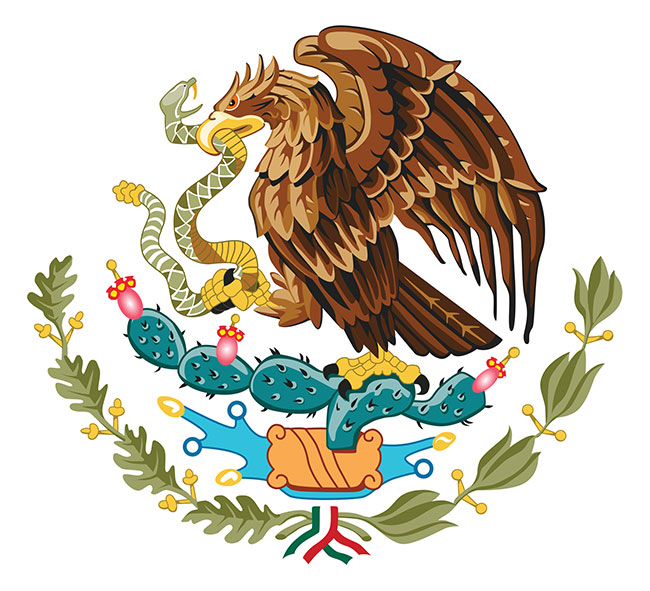
mexico-coat-of-arms-5200-2

Mexico Coat of Arms
Photo:  BigStockPhoto.com | Speedfighter

This civic holiday celebrates the Mexican flag and honors previous iterations. The holiday dates to 1937, when it was implemented by then-president Lázaro Cárdenas. The national flag, which features vertical stripes of red, white and green with the national coat of arms in the middle of the white stripe. Photo shows  Mexico Flag with enlarged coat of arms.

Mexicans first celebrated the country’s current flag on February 24, 1937. The design of this flag was used in 1821 and the current flag was officially adopted in 1968. Its colors – red, white, and green – are the National Liberation Army’s colors.

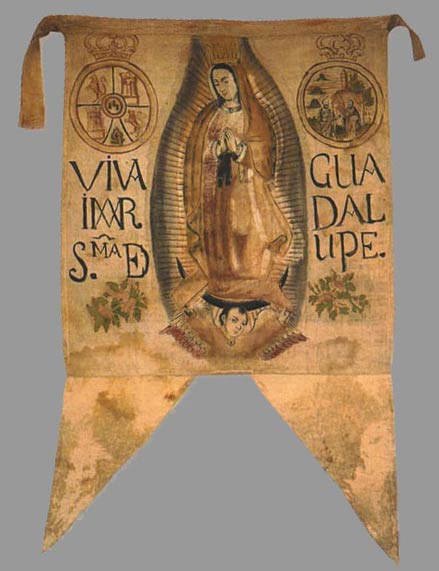
banner-guadalupano

Standard of the Virgin of Guadalupe carried by Miguel Hidalgo during the start of Mexico’s War of Independence in 1810. Image by Marcuse

Brief History of the Mexican Flag
The first flag was the banner of the Virgin of Guadalupe taken by the Atotonilco Chapel by the father of the nation, Don Miguel Hidalgo.  In Zitácuaro, Michoacan , on August 19 , 1812, emerged the flag of Generalissimo Morelos. This was a white frame with white and purple squares on the edges, an imperial eagle on the center, surrounded by a caption that says: ” UNGUIBUS EQUE VIC TRIX OCULIS ET”.

The Pennant “El Dolente de Hidalgo” was another flag used by the insurgents in the principles of the cause; it was red with crossed black stripes, a skull on the center of two crossbones in form of a cross.  The flag of the Insurgents, which was greeted with 19 cannon gunshots in New Orleans, it was formed by three vertical stripes: white, purple and red.


mexico-bandera-flag-2

Current Mexican Flag

“Trigarante Army Flag.” Born to the proclamation of the ” Plan of Iguala ” on February 24, 1821 , this date was subsequently chosen to celebrate the ” Day of the Flag ” .
The colors of this flag were the same as current and actual one, but placed differently and in diagonal stripes: first white , symbol of the ” Religion” , the center green ¨Independence¨, and finally the red symbolizing the “Union”, in the green stripe center there is an imperial crown with the motto of the three guarantees.

The Iturbide Empire Flag, replaced for the Iguala Flag, was the first to adopt the order of the present flag colors and the eagle in the center area , the difference was the position of the eagle holding an imperial crown.

The Republican Flag, enacted on April 14, 1823, was the most similar to the present flag; on this one appears the eagle but changed by placing it in front. The National Flag, as we know it today, waved for the first time in the National Palace on September 15, 1917.

————-

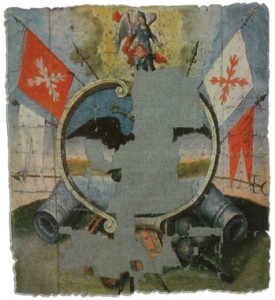
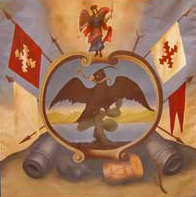
Back in the days, Spain had the last word. But today, and honoring Mexico’s festive mood, the Spaniards have sent back Hidalgo’s flag. It is the very flag that had been captured in Mexico in 1810/1811. It had been brought to Spain and put on display there in the Spanish Museo de Artillería (Artillery Museum).  Here is the good piece:

Source: www.emersonkent.com/history_notes/miguel_hidalgo_y_costilla.htm

historia-bandera-mexicana-pulsodigital-net

Images of the history of the Mexican Flag – Historia de la Bandera Mexicana – Photo: pulsodigital.net

A list of prior versions of the Mexican Flag can be found here:
https://en.wikipedia.org/wiki/List_of_Mexican_flags  and more here:
https://en.wikipedia.org/wiki/Flag_of_Mexico