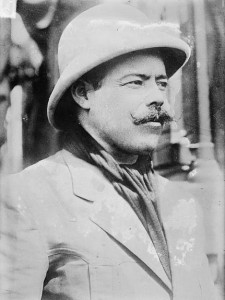
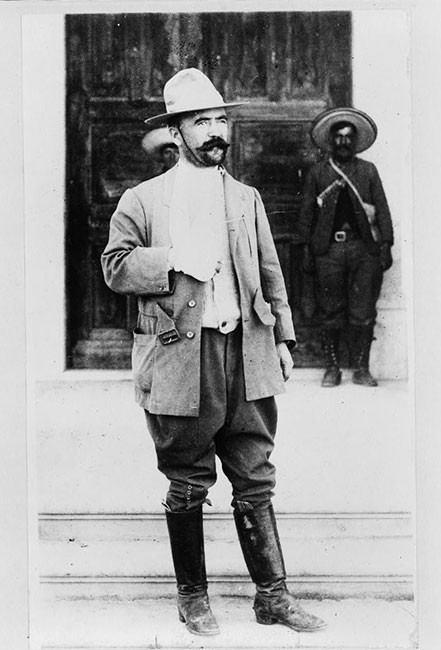
Hernán Cortés

Hernán Cortés (1485-1547)

hernan-cortes

Hernán Cortés – Public Domain Image

Hernán Cortés de Monroy y Pizarro, 1st Marquis of the Valley of Oaxaca was a Spanish Conquistador who led an expedition that caused the fall of the Aztec Empire and brought large portions of mainland …  Wikipedia

Hernán Cortés (1485-1547) was a Spanish conquistador, responsible for the audacious conquest of the Aztec Empire in Central Mexico in 1519. With a force of 600 Spanish soldiers he was able to conquer a vast Empire that had tens of thousands of warriors. He did it through a combination of ruthlessness, guile, violence and luck.

Cortés never lost the spirit of adventure. He personally financed and led an expedition to explore Baja California in the late 1530’s and fought with royal forces in Algiers in 1541. After that ended in a fiasco, he decided to return to Mexico, but instead died of pleuritis in 1547 at the age of 62.

Francisco Ignacio Madero González

Francisco Ignacio Madero González

franciso-madero-stamp-4393-2
A stamp dedicated to  Francisco Ignacio Madero Gonzalez a politician, writer and

revolutionary who served as President of Mexico from 1911 to 1913.
Photo circa 1985. bigstockphoto.com | markaumark


francisco-i-madero-portrait
Francisco Ignacio Madero González
(30 de octubre de 1873 – 22 de febrero de 1913)

https://es.wikipedia.org/wiki/Francisco_I._Madero

Born in Coahuila on October 30, 1873. Son of a wealthy landowner. Family was devoted to ranching, farming and commerce. Studied commerce and economics in France and agriculture in the U.S. Saw the need to improve conditions in Mexico.

Francisco-Madero-3c00794v-2General Madero, Mexican political leader, full-length portrait, standing,
facing right,  with hand in sling, after being wounded at Casas Grandes.
Date Created/Published: c1911.  Medium: 1 photographic print.
Library of Congress:  https://hdl.loc.gov/loc.pnp/cph.3c00794

Lázaro Cárdenas del Río, 1895 to 1970

lazaro-cardenas-mexico-portrait-2Lázaro Cárdenas del Río
Born: May 21, 1895 in Jiquilpan, Michoacán
Died: October 19, 1970 (aged 75) in Mexico City, Mexico
Nationality: Mexican
Political party: Party of the Mexican Revolution
Spouse(s): Amalia Solórzano

Lázaro Cárdenas was born on May 21, 1895 in a lower-middle-class family in the village of Jiquilpan, Michoacán. He supported his family (including his mother and seven younger siblings) from age 16 after the death of his father. By the age of 18 he had worked as a tax collector, a printer’s devil, and a jailkeeper. Although he left school at the age of eleven, he used every opportunity to educate himself and read widely throughout his life, especially works of history.

Cárdenas’s first move once he took office late in 1934 was to have his presidential salary cut in half. Even more surprising moves would follow. After establishing himself in the presidency, Cárdenas and the Mexican Congress turned on Calles and condemned his continued war-like persecution of the Catholic Church.  During his time in office, Cárdenas openly sought the National Revolutionary Party’s six-year plan of social and political reform.

Cárdenas’s efforts to negotiate with Mexican Eagle, in the managerial control of Royal Dutch/Shell and Standard Oil of New Jersey, were unavailing, and the companies rejected a solution proposed by a presidential commission. So at 9:45 pm on the evening of March 18, 1938, Cárdenas nationalized Mexico’s petroleum reserves and expropriated the equipment of the foreign oil companies in Mexico. The announcement inspired a spontaneous six-hour parade in Mexico City; it was followed by a national fund-raising campaign to compensate the companies.  https://en.wikipedia.org/wiki/L%C3%A1zaro_C%C3%A1rdenas

Feast Day of San Antonio de Abad, Saint Anthony Abbot

January 17 – Feast Day of San Antonio de Abad  (Saint Anthony Abbot)

The blessing of the animals is the most famous element of this day, which is the only day animals are allowed into Catholic churches.

Animals are adorned in ribbons and bows, and priests bless them.

feast-san-antonio-adad-333b5

Fotografía: Ángel Cantero. Bendición de animales el lunes 17 de enero de 2011, que tuvo lugar durante la mañana en la Plaza del El Salvador en Valladolid, con motivo de la celebración de San Antonio Abad. Iglesia en Valladolid Photo: www.flickr.com/commons/

January 17th is the Feast of San Antonio Abad, who is also known as San Antón in Spain. Although he was a hermit from Egypt, since Medieval times he has been the patron saint of domestic animals. To celebrate his feast, the night before and the day of the actual feast on January 17th, the Spanish build huge bonfires or hogueras in the streets, especially in Andalucia, Castilla-La Mancha, the Community of Valencia and Aragón. In Cataluna and the Balearic Islands, there are mounted processions in the streets. The townspeople gather around the bonfires, visit, eat, dance and drink.
https://spanishfood.about.com/b/2008/01/12/feast-of-san-antonio-abad.htm

feast-san-antonio-adad-9fda8

San Antonio Abad, Fotografía: Ángel Cantero. Bendición de animales en la Iglesia del Santísimo el Salvador el 17 de enero de 2011. Iglesia en Valladolid | www.flickr.com/commons/

This religious holiday is marked by the blessing of animals, which are allowed to enter Catholic churches for the day. An interesting view into Mexico’s dedication to religion, the day is marked by townspeople and farmers bringing pets and livestock to receive their blessings. Following animal-friendly church services, congregations and visitors enjoy a feast to celebrate. The event, which also showcases a number of spectacular local Catholic churches, is free.
More info here:
https://eventseeker.com/event/jan-17-2014/20127-feast-day-of-san-antonio-de-abad-monterrey

———-

If you like animals, there is no entertainment quite like seeing hundreds of pets, dogs, cats, horses, and even iguanas, snakes, and roosters, all converging in one square to be sprinkled with holy water!  January 17th,  is yet another important Saint’s Day in Spain, that of San Antonio Abad, patron saint of animals.

Naturally there’s an important backstory to Antonio Abad, also known as Anthony the Great. He was a Catholic (Coptic) monk born in 3rd-century AD Egypt who was known for spreading monasticism, but is now most famous for being the first to practice the asceticism of going into the wilderness to renew one’s faith through nature. This is how he became associated with animals. (Odd side note: He is also the Saint to whom you appeal to get rid of skin diseases, i.e. “St. Anthony’s fire”!)

On a day that celebrates animals in Spain, the horse is the central protagonist.  For the week or so leading up to his saint’s day, roughly January 11th through 17th, there are numerous equestrian exhibitions and “cabalgatas”, or cavalcades of horses passing through the streets all over Spain (especially in coastal towns and cities and on the islands).
See more at: https://www.thespainscoop.com/fiestas-de-san-antonio-abad-pets-have-festival/

st-anthony-abott
St. Anthony the Abbot is most well known as the Patriarch of Monks; the father of western monasticism. He is also the patron saint of grave-diggers and the protector of domestic animals such as cattle and other livestock. He is especially invoked by the people of Villavallelonga for the protection against the disaster from fire.
https://www.villavallelonga.com/patronsaints/santonio.html

Francisco Pancho Villa

José Doroteo Arango Arámbula – better known by his pseudonym Francisco Villa or his nickname Pancho Villa – was one of the most prominent Mexican Revolutionary generals. Wikipedia
Born: June 5, 1878, San Juan del Río, Durango
Full name: José Doroteo Arango Arámbula
Assassinated: July 20, 1923, Parral
Spouse: María Luz Corral (m. 1911–1923)

This is the most famous photo of Francisco Villa, and is part of ensallo (photo) and the film taken after the storming of Ojinaga. However I have always had the doubt if printed backwards either by words and numbers or the reins (reins of bridle) horse handled with the left hand and the whip (whip) right. Dr. Roberto Duarte  (Note: photo above has been Flipped Horizontally – words and numbers are viewed correctly)
Wall art advertising the Di Bruno Brothers' cheese shop in the south Philadelphia neighborhood, home to a large Italian-American community in Philadelphia, Pennsylvania (LOC)

francisco-pancho-villa-horseback-2Photo shows General Francisco “Pancho” Villa (1877-1923) on horseback, during the Mexican Revolution. Possibly taken at the time of the Battle of Ojinga, Chihuahua, which took place in January 1914. (Source: Flickr Commons project, 2010)
Forms part of: George Grantham Bain Collection (Library of Congress).

Jesús Roberto Duarte 
3y
Esta es la foto más famosa de Francisco Villa, y es parte del ensallo (fotográfico) y del film tomado después de la Toma de Ojinaga. Sin embargo siempre he tenido la duda si está impresa al revés ya sea por las palabras y números o por que las riendas (reins of bridle)del caballo se manejan con la mano izquierda y el fuete (whip) con la derecha. Dr. Roberto Duarte
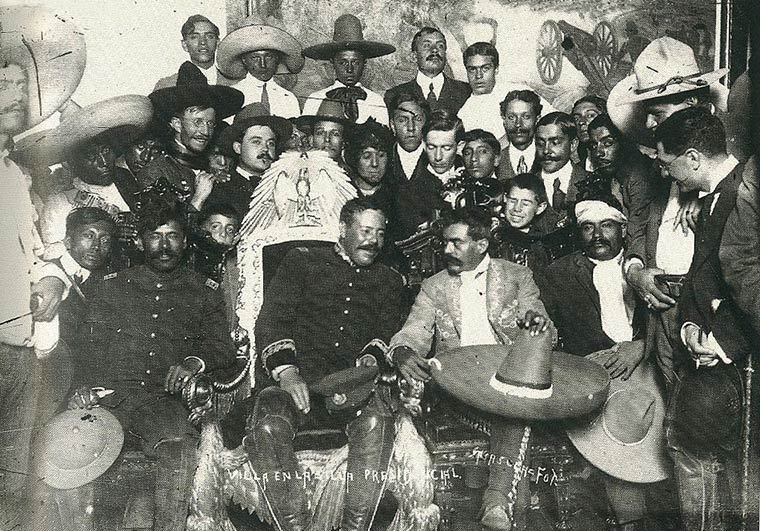
pancho-villa-mexico Los generales Villa y Zapata en la silla presidencial el 4 de diciembre 1914,
Palacio Nacional, durante la Revolución Mexicana.

generals-pancho-villa-zapata-5877-2Photograph similar to the one above, “Los generales Villa y Zapata”,
of a print on the wall of a restaurant in Los Cabos, México. Photo: Tyson
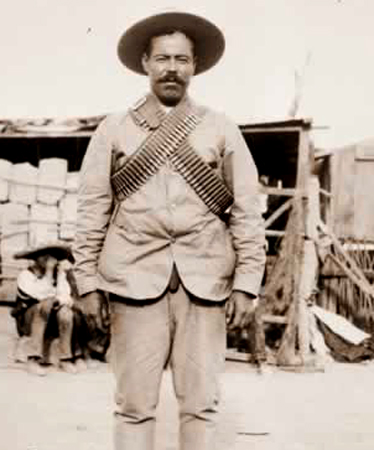
Pancho Villa - Library of Congress

Pancho Villa – Library of Congress

pancho-villa-biografia-nov11
pancho-Villa-close-up

Pancho Villa as he appeared in the United States press during the Revolution.

Description:
English: Mexican Revolution leader Pancho Villa
Date:     30 August 2011
Source:     Library of Congress
Author:     Bain Collection
https://en.wikipedia.org/wiki/File:Villa_close_up.jpg


Archivo Histórico, Universidad Nacional Autónoma de México

Archivo Histórico, Universidad Nacional Autónoma de México

Pancho Villa was assassinated on July 20, 1923. Villa was in his Dodge Sedan with his bodyguards, driving home from Parral to Canutillo.

A street vendor was waving to him at the intersection Benito Juarez / Gabino Barveda. Pancho slowed his car to return the greeting and the vendor shouted “¡Viva Villa!”. The shout was a signal for a squad of gunmen concealed in a house by the roadside.

They opened fire, the car swerved off the road and crashed into a tree. Villa was killed instantly, riddled by seven, some say nine, bullets. Four of his bodyguards were killed with him.

Among the ones killed were: Trillo (the chauffeur), and Daniel Tamayo (Villa’s assistant). Three members of his escort were wounded: Rafael Medrano, Ramón Contreras, and Claro Hurtado.
https://www.emersonkent.com/history_notes/pancho_villa.htm

pancho-villa-horseback-loc-1955vTitle: Pancho Villa | Date Created/Published: [between 1908 and 1919]
 Title from unverified data provided by the National Photo Company
on the negative or negative sleeve. Repository: Library of Congress